
 LETTER
FROM SUVARNABHUMI
LETTER
FROM SUVARNABHUMI
Coping
with the nightmare of noise
Published
in Nation on Oct 15, 2006
Noble
Park Village Tambon Bang Phli Yai Bang Phli District Samut Prakan
Once
again I woke with a start in the middle of the night because of the
ear-splitting engine sound from an aircraft over my house. It was as if the
plane was going to crash into our once tranquil home.
I
have not had an uninterrupted night of rest at home since September 28, the day
Thailand received huge media coverage for the opening of Suvarnabhumi Airport,
which boasts the world's largest passenger terminal and the world's tallest
control tower. (I am all too familiar with such bragging; many Thais are so
eager to boast they care little about the utility aspects.)
But
while many Thais feel proud about the country's new airport, I have woken up to
the grim fact that my peaceful life is a thing of the past. Like many other
people in my neighbourhood, thundering aircraft engines have been haunting us
most of the time.
I
watched the clock and found that the deafening sound came every five
minutes.
Actually,
my family moved in to the Noble Park Village less than two years ago because we
appreciated its tranquil environment. With the unbearable noise pollution from
the Suvarnabhumi Airport, we are now thinking hard about whether we need to
relocate again.
The
noise pollution weighs heavily on my heart because my five-year-old daughter,
Pinwad, has been adversely affected. From my observation, she no longer gets
proper sleep anymore.
Moreover,
her school is close by and also suffers from the noise pollution. (One of the
main reasons behind our family's decision to move into this development was that
it is near my daughter's school, meaning she would no longer have to get
exhausted from so much time travelling between school and home.) When I drop my
daughter off at school in the morning, I find the thunderous sound from the
passing planes unbearable. How can the students cope with this noise throughout
the day?
When
I raised the issue with my daughter, she insisted that she would not change her
school. She does not listen no matter how hard I try to explain to her that the
loud noise is not good for us, especially for her because her brain is still
developing at this age.
I
have also turned to neighbours to complain about the noise pollution. Aporn
Somprasertsuk, whose daughter is studying at the same school as Pinwad, said her
family was going to move out and she would enrol her daughter at another
school.
"We
can't sleep at night. How can we bear with it? No. We work so hard during the
day," Aporn said. "When we come home, we want to take rest and relax. But we
can't do that here any more. The tranquillity is gone. Life is now full of
stress. On some nights, I need to read till late at night hoping to fall
asleep."
As
I listened, my heart sank.
Aporn
said her daughter now moved restlessly in her sleep.
"We
are accustomed to a peaceful life. The noise here is too much to bear," she
said.
Another
neighbour said her one-month-old baby slept well but she worried whether the
deafening sound would affect the child in some unnoticeable way.
She
said she chose to keep her window open at night because she believes natural air
is better than air-conditioning.
I
myself would not dare to open the windows because even with them closed the
noise pollution is already too much.
Some
people told me that I would soon get used to the noise. Perhaps, I thought to
myself. But now I have told myself that I will just not be resigned to such a
fate.
To
many neighbours and myself, the sound has become increasingly deafening.
Sometimes we can't help suspect that some pilots might be ignoring rules about
flying over residential areas.
As
of now, we plan to contact the legal entity that manages our village. We hope to
discuss the problem and find solutions. We know a large number of affected
people feel the same way.
On
Tuesday night, I watched the "Theung Look Theung Khon" debate show on TV, which
focused on noise pollution caused by Suvarnabhumi. From what I heard, my
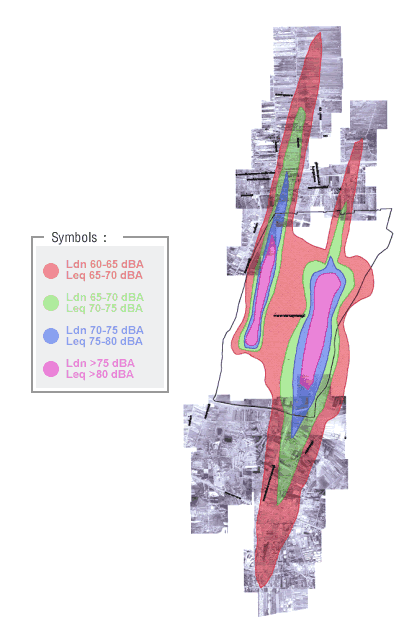
understanding is that Airports of Thailand Plc (AOT) will compensate affected
residents for relocation if their area has noise levels of over 75 decibels on
average each day. The compensation will be paid based on the estimated value of
their present home.
For
areas where the noise level averages less than 75 decibels, the AOT is going to
hand out compensation for home improvements to reduce the noise, such as
installing glass windows or air-conditioners.
The
main condition for the compensation is that the noise level must have risen by
more than 10 decibels following the opening of the new airport.
I
have no idea how much the noise level has increased in my village. But from what
I know, since the opening of the airport the noise pollution has subjected me to
sleepless nights and has left me feeling tired at the start of my day. I have
seen my daughter wake up with a start during the night. My mind feels
stressed.
Really,
I would like to invite AOT executives to spend a night or two at my home so that
they can empathise with us.
Somroutai
Sapsomboon
Response:
Postbag
Coping
with the Nightmare of Noise. One can only sympathise deeply with Somroutai
Sapsomboon whose family suffers the abominable noise of aircraft in the vicinity
of Suvarnabhumi airport (Nation, 15th October 2006). It is most unlikely that
her invitation to AOT officials to spend a night in her home will either gain
their notice or lead to a solution. Only mass legal action, led by KingMongut’s
Institute of Technology, is likely to focus attention on the problem.
Meanwhile
I presume to note the lesser problem of noise within the airport building and in
its vicinity. On Thursday last I made some spot measurements at the entrance to
and within the terminal. I am pleased to report that the noise levels were less
than in Don Muang, registering an average of 73 decibels.While this is not
grossly excessive it is still too loud for comfort and improvements are
required. The factors which are limiting the noise at present are the high
ceiling area which is not reflecting the sound down, the absence of a public
announcement system, of useless radio and television outputs. Most of the noise
appears to originate from high spirited and vociferous passengers. May I propose
that the airport authorities abstain from any measure which would increase the
present level of noise and set a target of reducing the average noise level by
an easily achievable one decibel per year. This is a barely noticeable
improvement, but in three years will reduce the noise power in the terminal by a
factor of two! I would propose in particular:
1.
Do not install the miserable audio loudspeakers which were everywhere in Don
Muang, nor the useless giant LCD videodisplays. No doubt if allowed to do so the
noisemakers of Don Muang will attempt to replicate the same cacophony as
before.
2.
Do not allow the open sided cafes and restaurants to broadcast music. At present
one is already doing so and others will follow. The result will be the noise
jungle of a BTS station.
3.
Stop the use of piercing whistles by those directing traffic at the terminal
building, the use of visible hand signals is sufficient.
4.
Attention to points 2 and 3 will probably reduce the current noise level by the
one decibel proposed as an annual goal. To plan further noise reduction, have
made a detailed noise map of the entire terminal and its vicinity so that the
areas of excessive noise can be identified and the sources suppressed.
None
of these measures involve expense beyond the normal administration of the
terminal. The entire environmental budget can instead be directed to solving the
far greater problems of environmental degradation in Ladkrabang
Danthong
Breen
People
who Love Quiet Club
Next
« Prev Post
« Prev Post
Previous
Next Post »
Next Post »
Đăng ký:
Đăng Nhận xét (Atom)