
 A
noise map is a method of showing noise levels in a city area. Parisians
identified noise as the main problem affecting their lives and a special
institute was set up to tackle the problem. One of the initiatives of the
Institute was to construct a noise map of the whole city where different noise
levels are portrayed in different colours. Using the map you can discover the
noise levels in parts of the city where you live, work, or travel through. You
can inspect the noise level in an area where you might consider living or
working.
A
noise map is a method of showing noise levels in a city area. Parisians
identified noise as the main problem affecting their lives and a special
institute was set up to tackle the problem. One of the initiatives of the
Institute was to construct a noise map of the whole city where different noise
levels are portrayed in different colours. Using the map you can discover the
noise levels in parts of the city where you live, work, or travel through. You
can inspect the noise level in an area where you might consider living or
working.
More
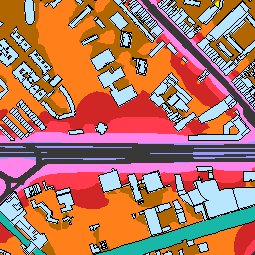
recently London has published a noise map; the area in the image above is a
small sample. Highest noise is the deep blue along roads, lowest noise is brown
with other colours showing intermediate levels. On the actual map, which can be
accessed on the Internet, the names of roads appear as the mouse pointer moves
over them.
The
London map makers provide the following explanation:
“Noise
maps will help to establish the existing baseline so that we will be able to
measure the effectiveness of future initiatives to control noise. They will also
let us see in an understandable and visual way how noise spreads from roads and
into residential areas. They will help us to see how different types of building
layout can affect the spread of noise, the havens of quiet that already exist
within the city, and how careful planning could create more of them. Noise maps
will help non-specialists develop a more intuitive feel for how noise behaves,
which will allow more people to appreciate the importance of planning and
designing against noise and to let them become involved in the process. They
will also give experts the tools to refine designs for maximum benefit at
affordable cost.”
Construction
the map is done as follows
“It’s
not so much that people are actually going out there and measuring the noise.
It’s getting together all of the data on traffic flows, traffic speeds, train
movements, aircraft movements, perhaps some noise measurements around industrial
sites. And then the software is used to calculate how that noise from the
sources propagates throughout the city. Tells you how bad the problems are in
cities like Birmingham and across the whole of the UK during this two-year
project.”
Poor
Europeans: “Well, the European Commission have estimated that around 20 percent
of the population of Europe are exposed to noise levels which are, they think,
unacceptable – that’s noise that was above 65 decibels. And that equates to
about eighty million people across Europe, which is a significant number of the
population.”
Poor
Bankokians: Please give us a noise map

Next
« Prev Post
« Prev Post
Previous
Next Post »
Next Post »
Đăng ký:
Đăng Nhận xét (Atom)